Collections and tags look similar when you first open Shopify. They both organize products and show up in your nav and filters. But they work completely in a different way. But mixing them up can cost you.
A wrong structure means customers can’t find what they’re looking for. That’s lost revenue, not a taxonomy problem.
Therefore, here’s exactly how collections and tags differ in Shopify and how to use each one to actually organize your store.
Collections are your store’s browseable categories. They appear in navigation menus, product pages, and collection URLs. Customers land on them, browse them, and shop from them.
Tags are internal labels. Customers don’t see them directly, but tags power your automated collections, store search, and product filtering. You can tag products, orders, and customers, each serving a different purpose.
The core rule: Use collections to build your store’s structure. Use tags to build your store’s logic.
- Collections create browseable categories with their own URLs. Tags are labels that work behind the scenes.
- Shopify has two collection types: Manual (you add products by hand) and Automated (products added by tag, price, vendor, or other conditions).
- Tags exist for three object types: products, orders, and customers. Each serves different operational purposes.
- The most powerful combo: tag your products consistently, then let automated collections manage themselves.
- Tags and metafields are different things. Tags are flat text labels. Metafields store structured data with specific field types.
Collections vs Tags at a Glance
Before going deep, here’s how the two features map against each other across the things that matter most to a Shopify merchant.
| Criteria | Collections | Tags |
|---|---|---|
| What it is | A browseable group of products with its own page and URL | A text label attached to a product, order, or customer |
| Visible to customers | Yes — in navigation, product pages, and collection URLs | Not directly — hidden from storefront but powers search and filtering |
| Has its own URL | Yes — /collections/[handle] | No standalone URL by default |
| Affects SEO | Yes — collection pages are indexed and can rank | Indirectly — tags affect internal search relevance |
| Can be automated | Yes — automated collections update by product conditions | Tags are the conditions that drive automation |
| Applied to | Products only | Products, Orders, and Customers |
| Max per product | A product can be in multiple collections | Up to ~250 tags per product (practical limit) |
| Used for navigation | Yes — primary navigation structure | No — used for backend filtering and automation logic |
What Are Shopify Collections?
In Shopify, a collection is a curated group of products that shares a common attribute, type, season, price range, use case, or anything else you define. Every collection gets its own storefront page at /collections/[handle], its own title, description, and image, and can appear in your navigation menu.
Think of collections as the architecture of your store. They answer the question, “How does a customer browse from your homepage to a specific product?” If you organize your products well, collections become the backbone of your entire store navigation.
Types of Shopify collections
When you add a collection to your store, you will get two options. You can either go for a manual collection or an automated collection. You can also have both types of collections in your store.
Let’s check out the types of collections.
1. Manual collection
A manual collection is exactly what it sounds like; you choose every product in it by hand. You add products, you remove products, nothing changes unless you do it yourself.
This gives you full control. If you want a “Staff Picks” collection that never changes automatically, or a curated “Holiday Bundle” of specific products, manual collections are the right tool. The trade-off is maintenance overhead. Every time you add a new product that belongs in the collection, you have to remember to add it manually.
Manual collections work best for
- Curated or editorial product groupings
- Promotional or limited-time collections you control entirely
- Small stores where maintaining lists by hand is manageable
2. Automated collection
An automated collection, also called a Smart Collection, uses conditions you define to add and remove products automatically. When a product matches the conditions, it appears in the collection. When it no longer matches, it drops out. No manual work required after setup.
You can set up to 60 conditions per automated collection. Conditions pull from product attributes including title, type, vendor, price, inventory, weight, and, most importantly for this guide, product tags.
Conditions of Shopify automated collections
When setting up an automated collection, you choose whether products must match all conditions (AND logic) or any condition (OR logic). This lets you build precise rules: a “Men’s Clearance” collection that requires both the “men” tag AND a price under $30.
Once a product meets the conditions of an automated collection, Shopify adds it automatically within minutes. You don’t need to refresh anything, trigger a workflow, or manually approve the product.
Automated collections work best when you have consistent, structured product data. Tags are the most common trigger — which is exactly why understanding how tags work is essential to getting the most out of collections.
If you want to display your collections in a slider or featured section on your homepage, check out how to create a Shopify collection slider to present them visually.
What Are Shopify Tags?
Tags in Shopify are short text labels you attach to objects in your store. They are flexible, free-form, and do not have their own page or URL. Customers do not see your tags directly, but tags are working hard behind the scenes on search relevance, automated collection logic, and store filtering.
Here’s the key thing most guides miss: Tags are not just for products. Shopify has three types of tags, each for a different object.
1. Product Tags
Product tags are the most widely used. You attach them to individual products to describe attributes that don’t fit neatly into standard product fields, things like “sale,” “new-arrival,” “winter-2026,” or “gift-idea.”
Product tags power two important things in Shopify:
- Automated collection conditions: Tag a product, and it automatically joins the right collection
- Shopify’s internal search: The search algorithm uses tags to surface relevant results for shoppers
Product tags also enable collection filtering in themes that support it. In the Dawn theme and other Online Store 2.0 themes, customers can filter products within a collection by tag, seeing only “red” or “sale” items, for example.
2. Order Tags
Order tags are attached to individual orders, not products. You use them to categorize and track orders through your fulfillment workflow. Common examples include rush-order, gift-wrap, wholesale, or requires-review.
Order tags are particularly useful if you use Shopify Flow or third-party fulfillment apps that trigger actions based on tags. A tag of priority on an order, for example, can automatically route it to a different fulfillment queue.
3. Customer Tags
Customer tags are applied to customer profiles. They let you segment your customer base for targeted marketing, discount eligibility, or custom pricing. Examples: VIP, wholesale-partner, loyalty-tier-gold.
Customer tags integrate with Shopify’s discount logic and many email marketing apps. If a customer has the tag VIP, you can automatically apply a discount code or grant access to a members-only product page.
Tags are case-insensitive in Shopify, but inconsistent naming often breaks automation and creates management headaches. Terms like “NewArrival”, “new-arrival”, and “New Arrival” may look similar to humans, but can create confusion across workflows and collection rules.
Establish a naming convention before you scale. Lowercase tags with hyphens are typically the easiest to manage, search, and automate consistently.
How to Add Tags in Shopify
The process is slightly different depending on whether you’re tagging a product, an order, or a customer. Here’s each one.
How to Add Product Tags
- Go to products in your Shopify admin: From the left sidebar, click Products, then click on the product you want to tag.
- Find the Tags field in the right sidebar: On the product edit page, scroll down the right-hand panel. The Tags field appears below the Product organization section (below Type and Vendor).
- Type your tags and press Enter: Click in the Tags field, type a tag name, and press Enter or a comma to confirm. Repeat for additional tags. Existing tags in your store will appear as suggestions as you type.
- Click Save: Tags apply immediately. Any automated collection using those tags will update within minutes.
How to Add Order Tags
- Go to Orders in Shopify admin: Click on the order you want to tag to open the order detail page.
- Find the Tags section: In the right panel of the order detail page, scroll down to find the Tags field. Click to add your tag and press Enter to save.
How to Add Customer Tags
- Go to Customers in Shopify admin: Click on a customer profile to open it.
- Find the Tags field: In the right panel, look for the Tags section. Add your tag and press Enter. The tag is saved to that customer’s profile.
You can also tag products in bulk. From the Products list, select multiple products using the checkboxes, click the Actions dropdown, and choose Add tags.
This can save significant time when migrating or reorganizing a large catalog.
If you need to locate a specific product before tagging it, see our guide on how to find a Shopify product ID quickly .
How Tags Work with Automated Collections
This is where collections and tags come together and where most of the real power lives. Once you understand this, the entire organizational logic of Shopify clicks into place.
An automated collection watches your product catalog and applies conditions to decide what belongs. The most flexible condition type is product tag.
Here’s how to set it up:
Go to Products → Collections → Create Collection
In Shopify admin, navigate to Products → Collections, then click Create Collection.
Give Your Collection a Name and Select Automated
Name your collection, then under Collection Type, select Automated (not Manual).
Set a Tag-Based Condition
Under Conditions, set the first dropdown to Product Tag, the second dropdown to Is Equal To, then type your tag in the text field.
Example: sale
Add More Conditions if Needed
Click Add Condition to layer additional rules. For example, create a collection for products tagged with sale and priced below $50.
Save the Collection
Click Save. Shopify automatically scans your catalog and populates the collection with matching products. Any product tagged with sale will join the collection automatically.
This is the most scalable way to manage product organization. You don’t need to manually update collections every time you add a product; you just tag it correctly, and the right collections update themselves.
If you reach the limit, you’ll need to edit existing conditions or create an additional collection to handle the overflow.
For large catalogs, plan your tagging taxonomy before building your collection structure.
Changing tag names later can become time-consuming because every product using those tags must be updated as well.
Once your automated collections are running, you can display them beautifully on your homepage or feature pages. Check our Shopify sub collections guide to see how to nest collections and build a more layered navigation structure.
Collections vs Tags vs Metafields
Merchants often ask where metafields fit into this picture. Tags and metafields both attach additional information to products, but they work very differently and serve different purposes.
| Feature | Collections | Tags | Metafields |
|---|---|---|---|
| Data Type | Grouped product list | Free-form text label | Structured data (text, number, date, file, reference) |
| Displayable on Storefront | Yes — collection pages | Via Liquid filters or filtering apps | Yes — directly in Liquid templates and the theme editor |
| Used for Automation | Yes — automated collections can use conditions | Yes — most common automation condition | No — not supported as collection conditions |
| Can Be Filtered in Shopify Search | Yes — by collection | Yes — tag-based filtering in Online Store 2.0 themes | Yes — via Shopify Search & Discovery app |
| Best Used For | Navigation structure and browseable categories | Automation, labeling, and search relevance | Custom product data: materials, dimensions, certifications, specifications |
| Requires Theme Support | No — standard in all Shopify themes | Partial — filtering requires Online Store 2.0 themes | Yes — displaying metafields requires Liquid template editing or OS 2.0 metafield blocks |
In short: tags are the fastest and most flexible way to build automation logic. Metafields are the right tool when you need to store structured product data, material type, care instructions, or compatibility specs that you want to display on the product page and use in search filters. The two can coexist on the same product without conflict.
When to Use Collections vs Tags
Here’s a direct framework for making the call. For each situation, there’s a clear answer.
For most Shopify stores, the right answer is both: collections for structure and navigation and tags for automation and filtering. They complement each other and work best together. If you’re building a store with a large catalog, see our complete guide on how to organize products on Shopify for a full system that combines collections, tags, and navigation into one coherent structure.
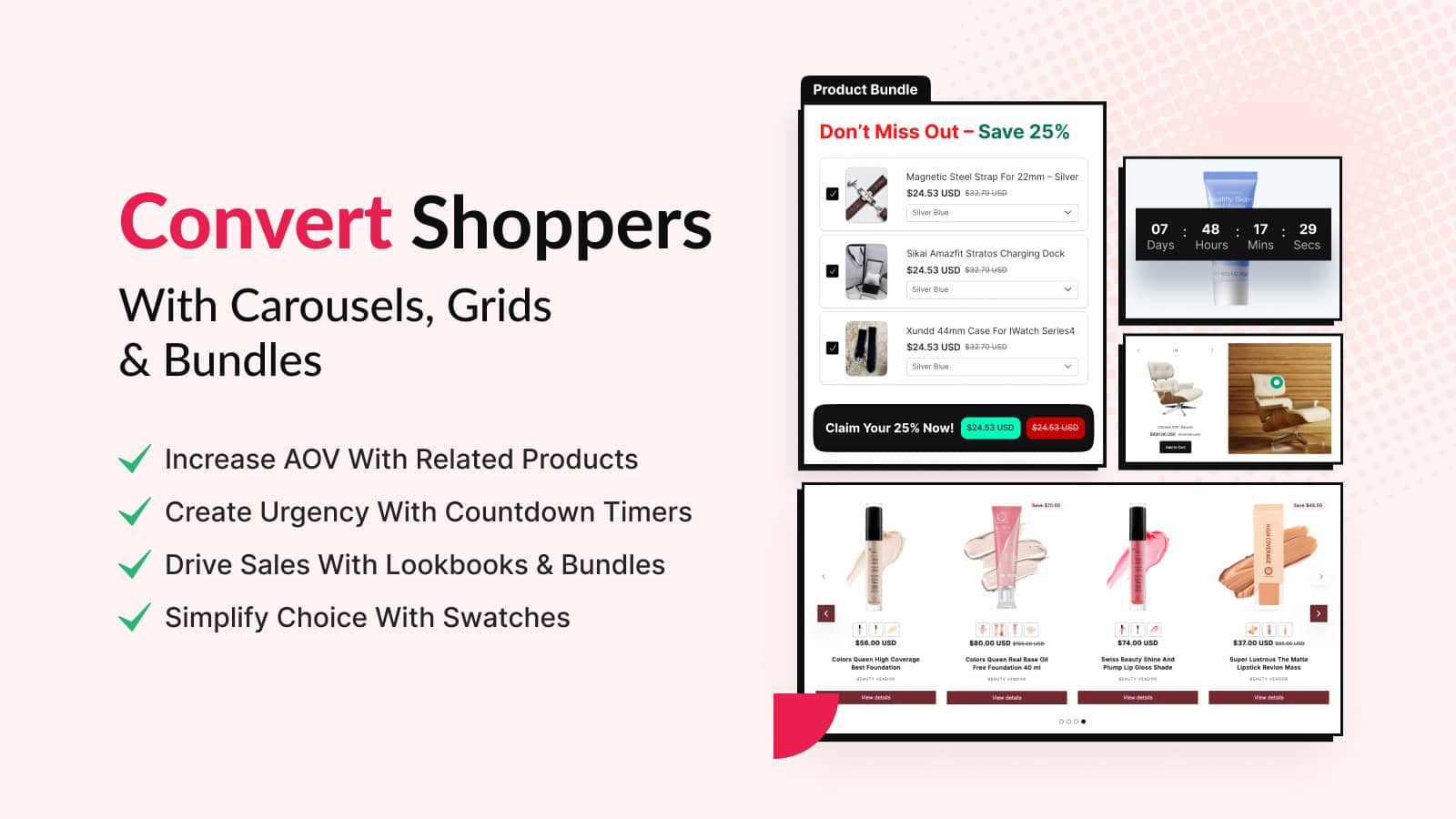
EasyBoost: Boost Sales with the Product Showcase App
- Display products by collection, tag, or condition — Best Sellers, New Arrivals, On Sale.
- Slide or Grid view with conversion-focused templates.
- Product Labels, Badges, and Sale Countdown Timer.
- Integrates with Judge.me, Loox, Yotpo, ReviewXpo, Stamped, and more.
Frequently asked questions
What is the difference between Shopify collections and tags?
Collections are browseable categories with their own storefront pages and URLs. Tags are internal labels with no standalone page. Collections are for navigation and SEO. Tags are for automation, filtering, and backend organization. Most stores use both together.
How do I add tags to products in Shopify?
Go to Shopify admin > Products > click any product > find the Tags field in the right sidebar > type a tag name and press Enter. Click Save. For bulk tagging, select multiple products from the product list, click Actions, then Add tags.
Can I use tags to create collections in Shopify?
Yes. When creating an automated collection, set the condition to “Product tag is equal to [your tag].” Every product with that tag joins the collection automatically. This is the most common way to build scalable, self-updating collections in Shopify.
What are the different types of tags in Shopify?
Shopify has three tag types: Product tags (for search, filtering, and automated collections), Order tags (for fulfillment tracking and workflow automation), and Customer tags (for segmentation, discounts, and email marketing). Each type appears in a different section of the Shopify admin.
What is the difference between manual and automated collections?
Manual collections require you to add and remove products by hand. You have full control but no automation. Automated collections use conditions — tag, price, type, vendor, inventory — to add and remove products automatically. Use manual for curated or editorial lists. Use automated for any collection that should update as products change.
Do Shopify tags affect SEO?
Not directly. Tags don’t have their own indexable pages by default. However, they affect your Shopify internal search relevance, which improves product discoverability on your storefront. Collections do get their own URLs (/collections/[handle]) and can rank in search engines independently.
How many conditions can I add to an automated collection?
Up to 60 conditions per automated collection. If you reach the limit, you’ll need to edit existing conditions or create a separate collection to handle additional logic. For complex catalogs, it’s worth planning your tag taxonomy before building collections to avoid hitting this ceiling.
Need Help Organizing Your Shopify Store?
Collections, tags, metafields, and store structure can get messy as your catalog grows. The ShopiDevs team can help you organize and scale it the right way.

I’m a digital marketing expert with a deep understanding of Shopify App Store optimization. I contribute insightful articles on Shopify to help businesses thrive online.