
Instagram content converts better than static product photography. Posts showing real customers wearing, using, or reviewing a product generate 4x higher click-through rates than branded content alone. The problem is that this content sits on Instagram while your Shopify store shows none of it.
Adding an Instagram feed gallery to your store closes that gap. Visitors see real posts, real engagement, and real brand activity without leaving the product page. This guide covers three methods to add an Instagram feed to Shopify, including the fastest no-code option with Essential Grid Gallery, a custom API approach for developers, and a manual embed method for single posts.
The easiest way to add an Instagram feed to Shopify is with an app like Essential Grid Gallery. Install the app, choose an Instagram gallery template, connect your Instagram account, and publish the gallery as an app block inside your theme. Most stores can complete the setup in under 15 minutes without writing code.
If you want a live feed that automatically updates whenever you publish new Instagram posts, use the app method. If you only need to display a single Instagram post or Reel, you can use Instagram’s native embed code inside a Custom Liquid section.
- There are three ways to add an Instagram feed to Shopify: an app, custom API development, or manual Instagram embed.
- Essential Grid Gallery is the easiest option for most stores and supports grid, carousel, masonry, and shoppable Instagram galleries.
- Manual embeds only display individual Instagram posts or Reels and do not create a gallery or auto-sync new content.
- Instagram feed apps have minimal performance impact when lazy loading is enabled because images load only as visitors scroll.
- Most Instagram gallery apps require an Instagram Business or Creator account to access the Instagram API.
Why Add an Instagram Feed to Your Shopify Store?
An Instagram feed brings the social proof your store already has on social media onto the pages where buying decisions happen. The concrete benefits are measurable:
- Real social proof at the decision point. Shoppers see authentic customer posts on the same page as the buy button, not three clicks away on another platform.
- Longer session duration. Stores with visual gallery sections see 15 to 30% longer session duration compared to stores with static product grids. Longer sessions mean more product pages visited. Pairing a gallery with a product slider or product banner on the same page compounds this effect.
- Higher trust for first-time visitors. Seeing real posts from real accounts tells new visitors the brand is active and that people actually buy from it.
- Auto-updating content. Unlike a static image section, a synced Instagram feed refreshes automatically when you post new content. Your store stays visually current without manual updates. Combine with a sale banner during campaigns to align Instagram promotion with your on-site messaging.
- Shoppable UGC. With apps like Essential Grid Gallery, you can tag products in Instagram posts so visitors can click a photo and go straight to the product page. High-performing beauty and fashion stores use this to turn inspiration into direct conversions. See how top Shopify beauty stores use shoppable galleries to increase average order value.
3 Methods to Add Instagram Feed to Shopify: Quick Comparison
| Method | Setup Difficulty | Auto-Syncs | Gallery Support | Best For |
|---|---|---|---|---|
|
App (Essential Grid) Recommended |
Very Easy | Yes | Yes (Grid, Carousel, Masonry, Shoppable) | Most Shopify stores, no coding required |
| Custom API Development | Very Hard | Yes (Custom) | Yes (Full Control) | Large brands with in-house developers |
| Manual Embed Limited | Easy | No | No (Single Post Only) | Embedding one specific Instagram post or Reel |
Method 1: Add Instagram Feed with Essential Grid Gallery (Recommended)
Essential Grid Gallery connects directly to your Instagram account and automatically displays your latest posts in a fully customizable gallery. It supports grid, carousel, masonry, and shoppable layouts with automatic syncing whenever you publish new content. The free plan includes one gallery, three templates, and up to 12 images, while paid plans unlock additional galleries, templates, and advanced customization options for growing Shopify stores.
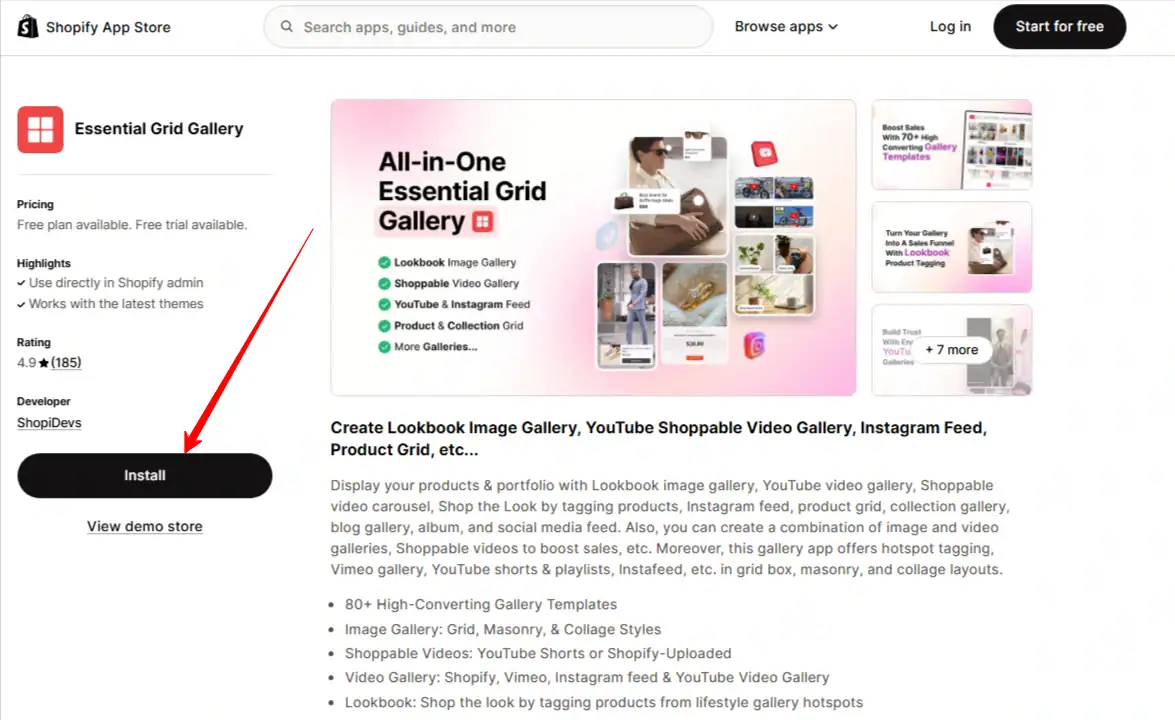
Step 1: Install Essential Grid Gallery from the Shopify App Store
- Open the Shopify App Store and search for Essential Grid Gallery
- Click Install and approve the required permissions to complete setup
Step 2: Choose a Template or Start from Blank
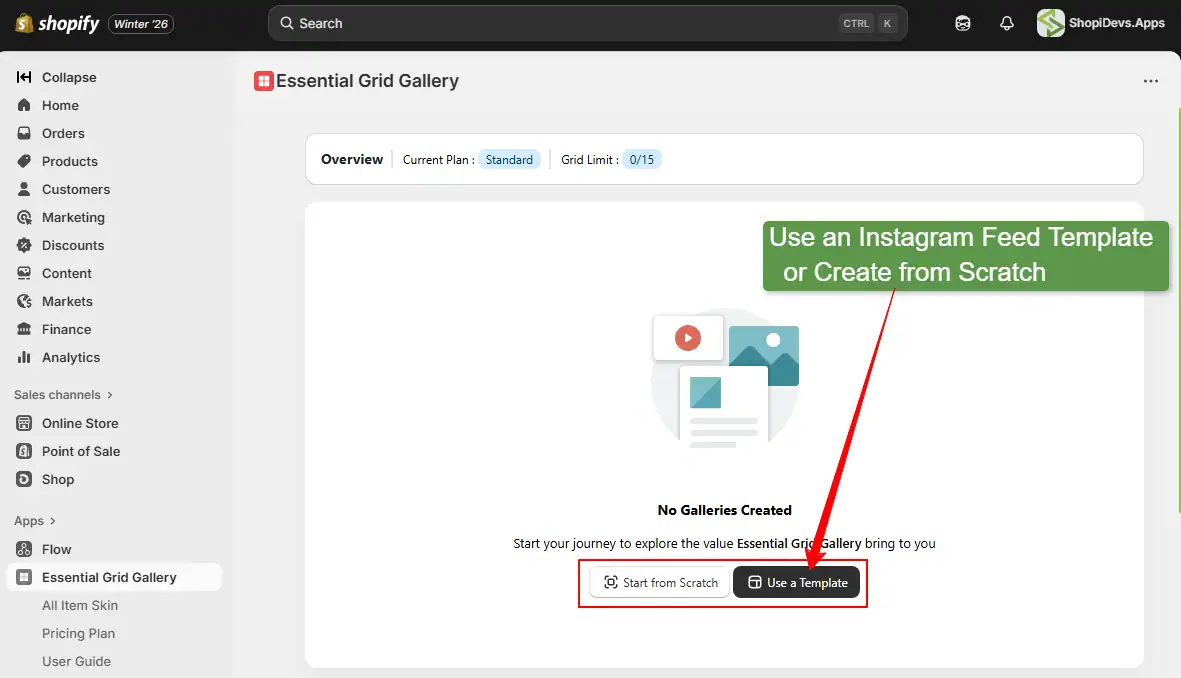
Inside the Essential Grid Gallery dashboard, you have two starting points:
- Start from Scratch for full layout control (recommended for advanced users)
- Use a Template for a faster setup using a pre-built Instagram feed design
Step 3: Select an Instagram Feed Template
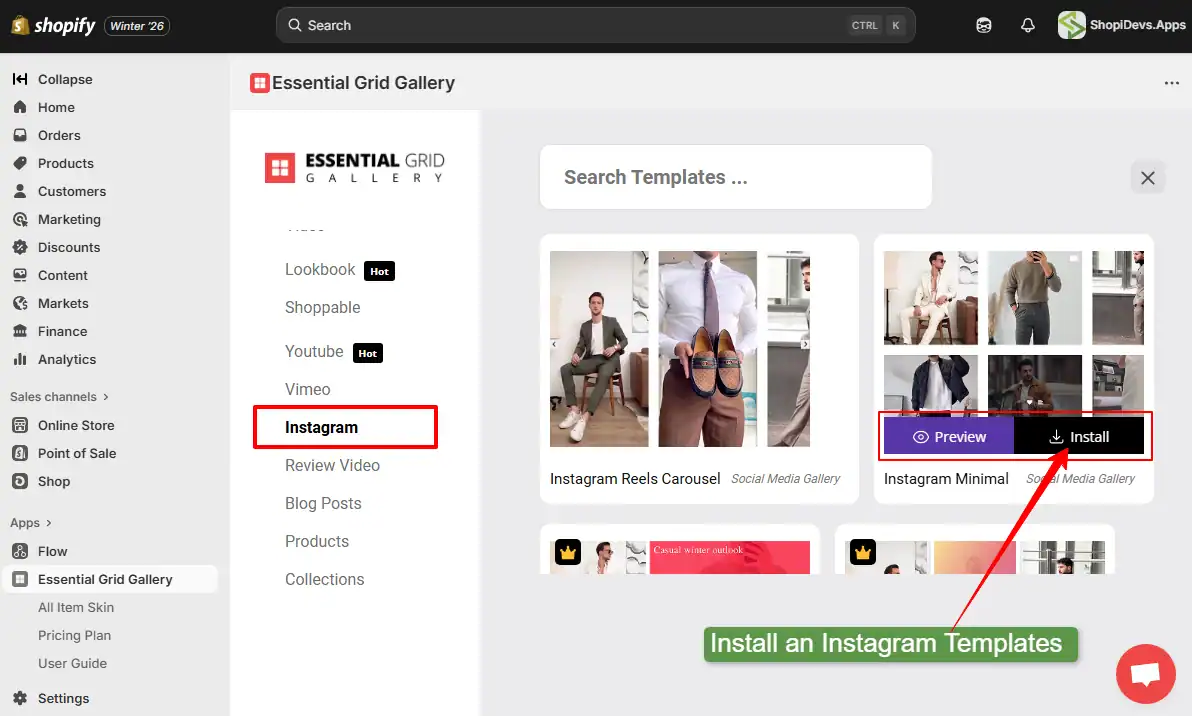
- Click the Instagram tab to filter templates to Instagram-specific layouts
- Preview the demo feed and click Install / Import on your chosen template
- Click Install to import the template into your gallery editor
Step 4: Connect Your Instagram Account
- Click Connect Instagram Account in the gallery editor
- Log in to your Instagram Business or Creator account when prompted
- Set the number of posts you want to display in the gallery
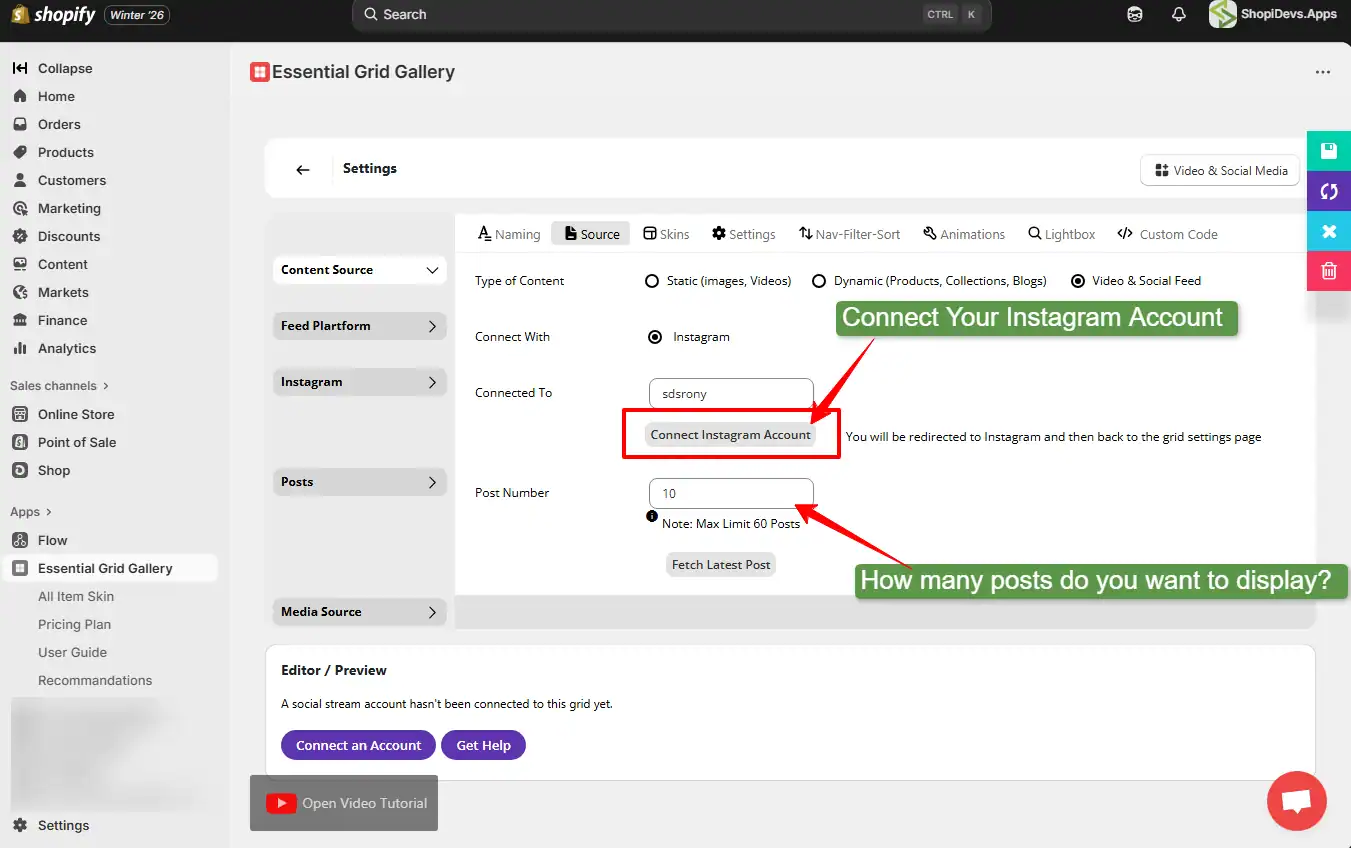
Note: Essential Grid Gallery requires an Instagram Business or Instagram Creator account because Meta only allows gallery-style API access for professional accounts. Personal Instagram accounts cannot be connected to auto-sync gallery apps.
Step 5: Customize Gallery Settings
The template imports with its default layout. You can adjust the layout, loading behavior, and visual settings from the editor:
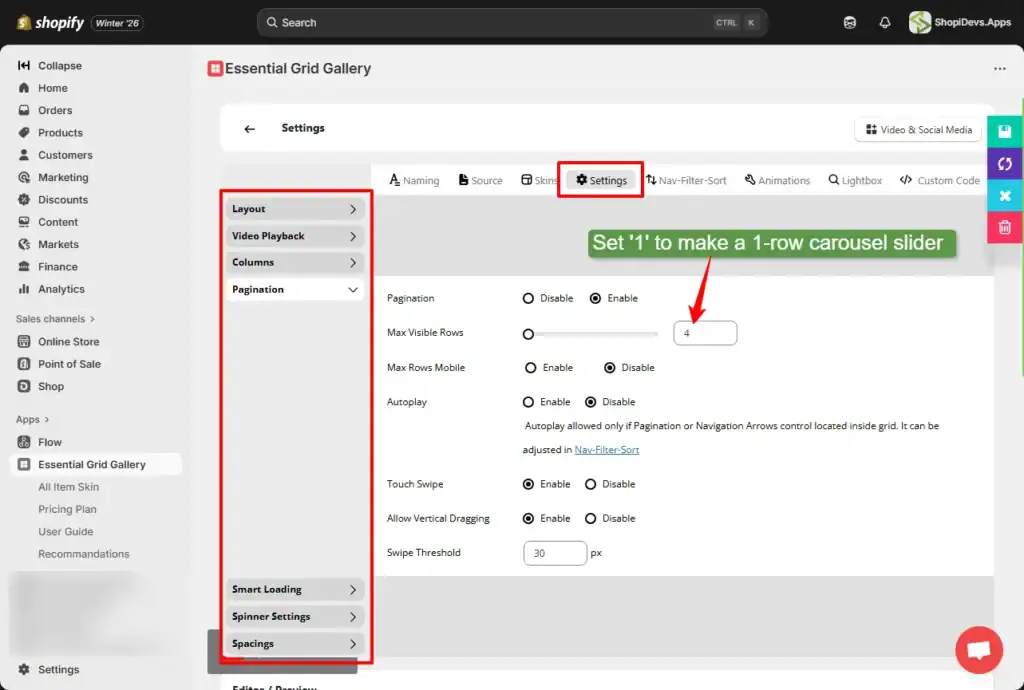
- Set Row value to 1 and disable pagination to convert the grid into a horizontal carousel layout
- Enable lazy loading to prevent the gallery from affecting your store’s page speed score
- Set loading animation style (fade, slide, scale) from the animation options
Step 6: Save and Publish the Gallery
- Click Save to save your gallery configuration
- Go to the Naming tab and copy the Gallery ID
- Select the store page where you want the feed to appear and click Publish
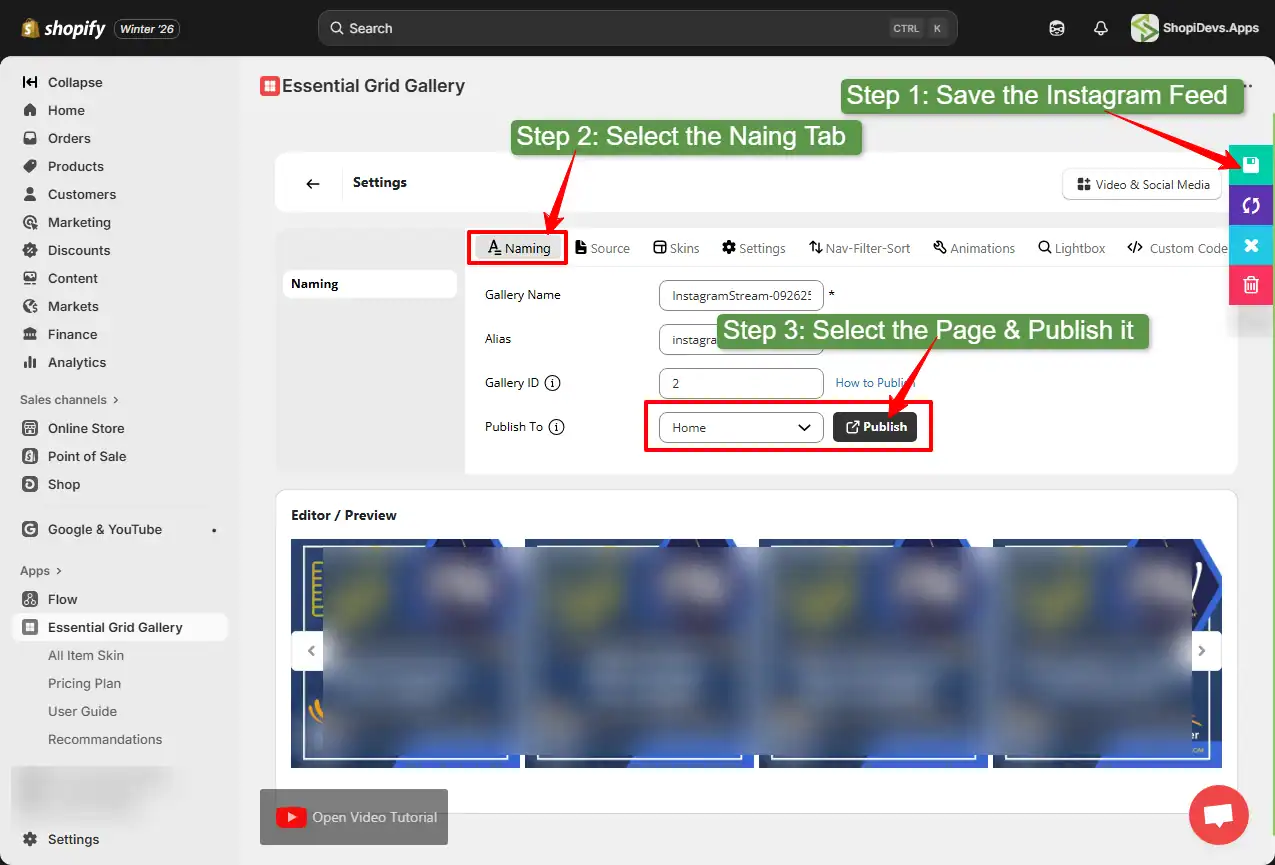
After clicking Publish, you are redirected to the Shopify theme editor with the Essential Grid app block already added to the selected page.
Step 7: Embed the Gallery in the Theme Editor
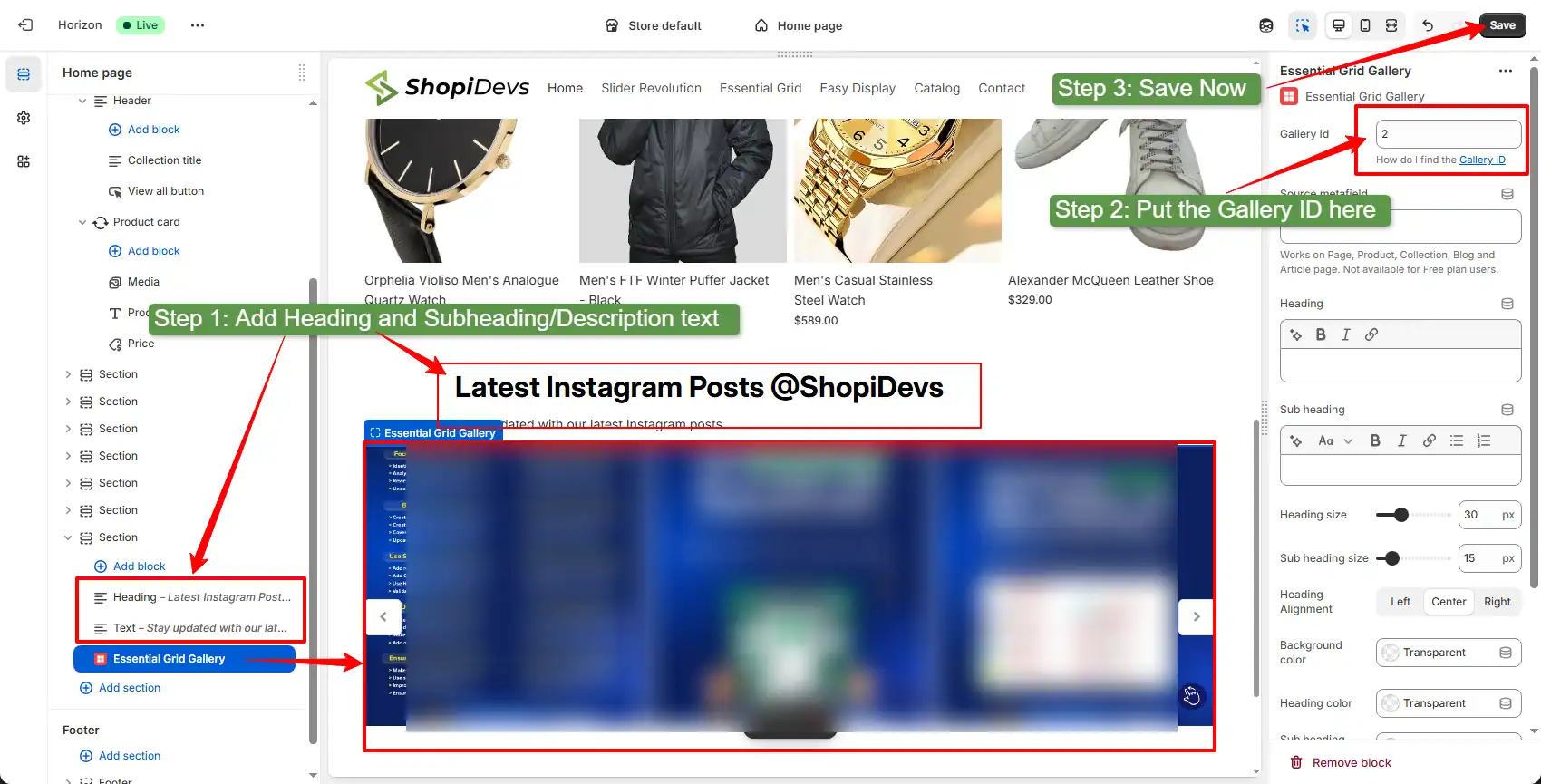
- Paste the Gallery ID you copied in Step 6 into the app block field
- Optionally add a heading and description text above the gallery for context
- Click Save in the theme editor
Step 8: Test on Mobile and Desktop
Use the theme editor’s device preview to check how the gallery looks on mobile before publishing. Confirm that lazy loading works correctly and that images load progressively as the visitor scrolls.
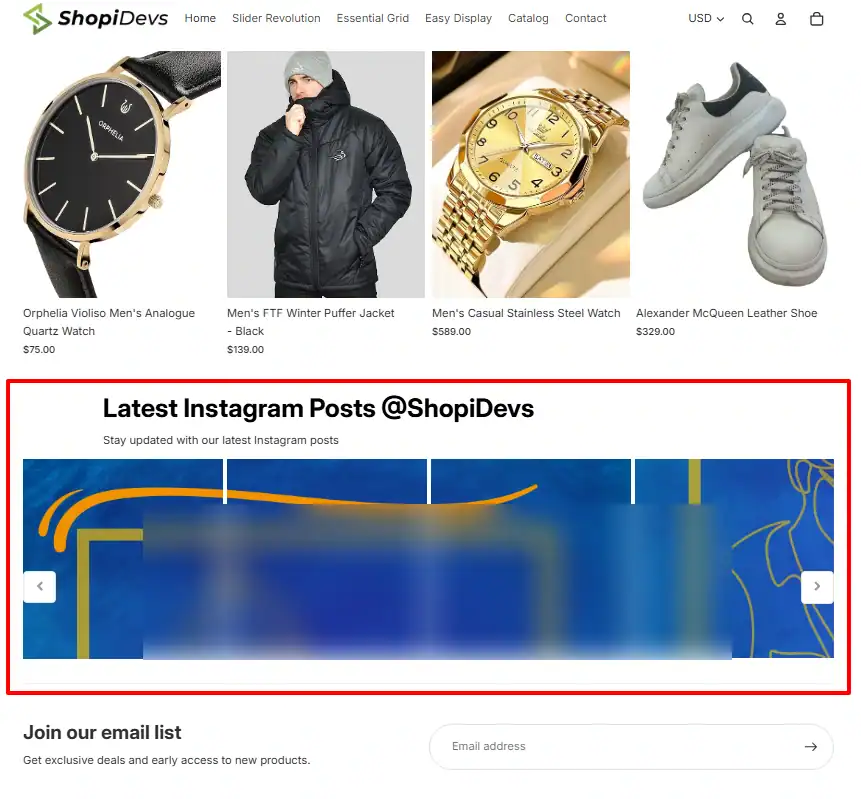
Tip: Essential Grid Gallery supports far more than Instagram feeds. Create shoppable lookbooks, build a video carousel for Instagram Reels or product videos, or showcase products in responsive masonry galleries. Everything is managed from one dashboard without writing code.
Method 2: Custom Development Using the Instagram Graph API
Building a custom Instagram integration gives you complete control over the gallery design, data processing, caching, and theme integration. It uses Meta’s official Instagram Graph API to fetch posts and display them with custom Liquid, JavaScript, and backend code. This approach is best suited for large brands with unique design requirements and access to experienced Shopify developers.
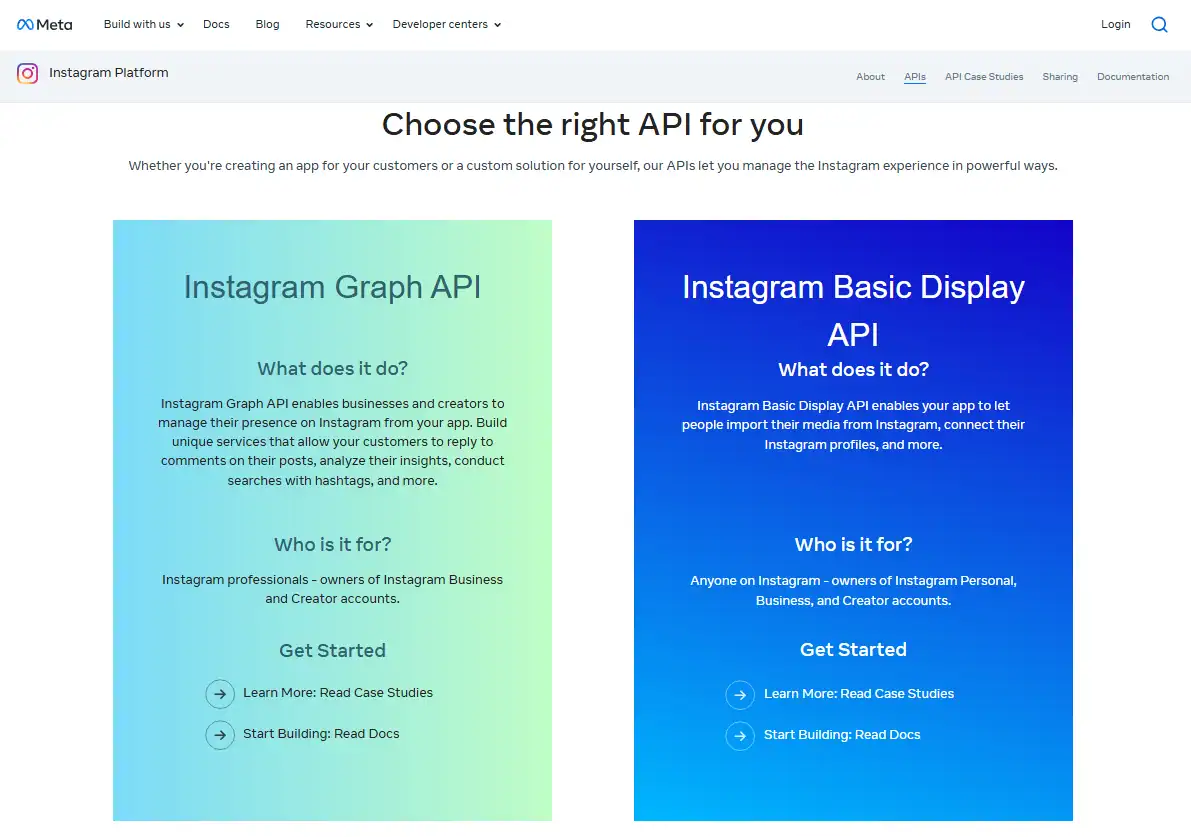
This method requires a Facebook Developer account, an approved Instagram app with the instagram_basic and instagram_content_publish permissions, and a Shopify developer who can write and maintain the integration code.
Key requirements before starting:
- Instagram Business or Creator account linked to a Facebook Page
- Facebook Developer account with an approved app
- Access token management (tokens expire and must be refreshed)
- A backend service or serverless function to handle API calls (Instagram’s API cannot be called directly from the browser due to token exposure)
- Ongoing maintenance budget: any Instagram API update or permission change requires developer time to fix
This approach suits large brands, agencies with in-house development teams, or headless Shopify builds where apps cannot be used. For standard Shopify stores, the app method is faster to deploy and easier to maintain long-term.
Method 3: Manually Embed a Single Instagram Post or Reel
Building a custom Instagram integration gives you complete control over the gallery design, data processing, caching, and theme integration. It uses Meta’s official Instagram Graph API to fetch posts and display them with custom Liquid, JavaScript, and backend code. This approach is best suited for large brands with unique design requirements and access to experienced Shopify developers.
Step 1: Find the Embed Option on Instagram
- Log in to your Instagram account from a desktop browser
- Open the post or reel you want to embed
- Click the three dots (…) in the top right of the post
- Select Embed from the menu
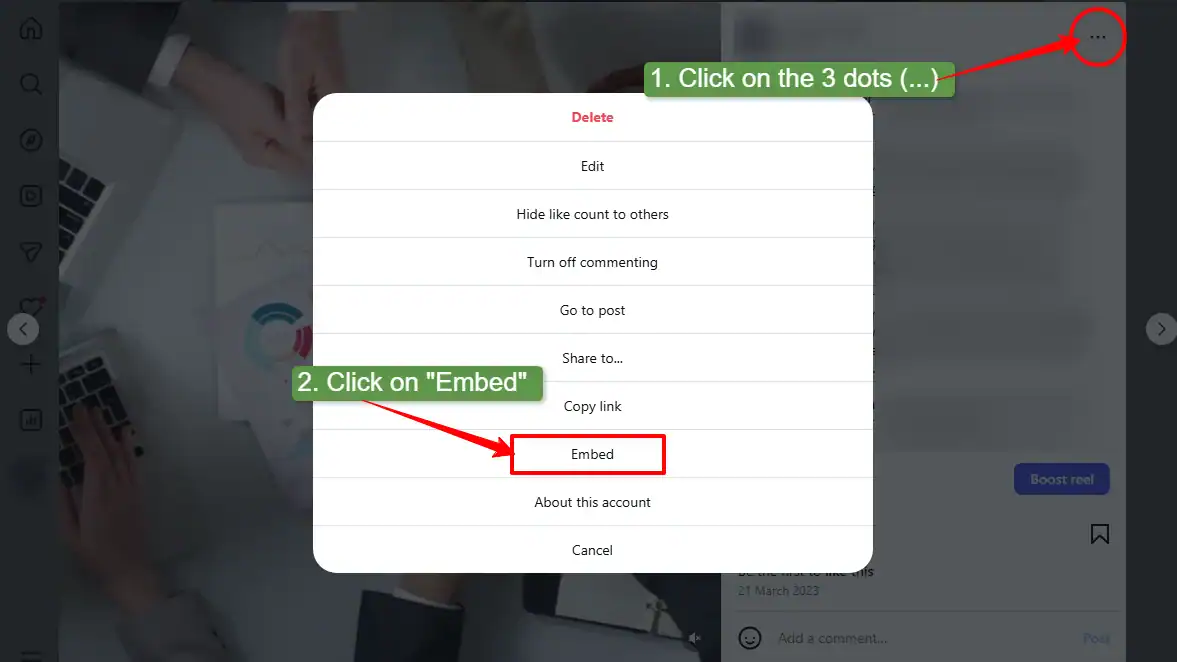
Step 2: Copy the Embed Code
- Check or uncheck Include Caption based on your preference
- Click Copy Embed Code
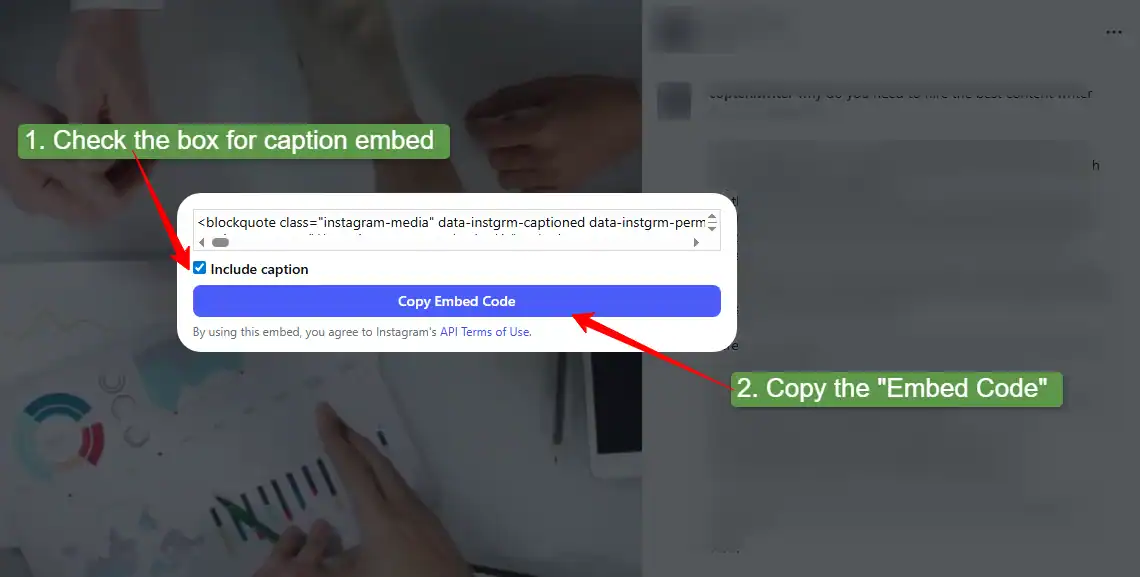
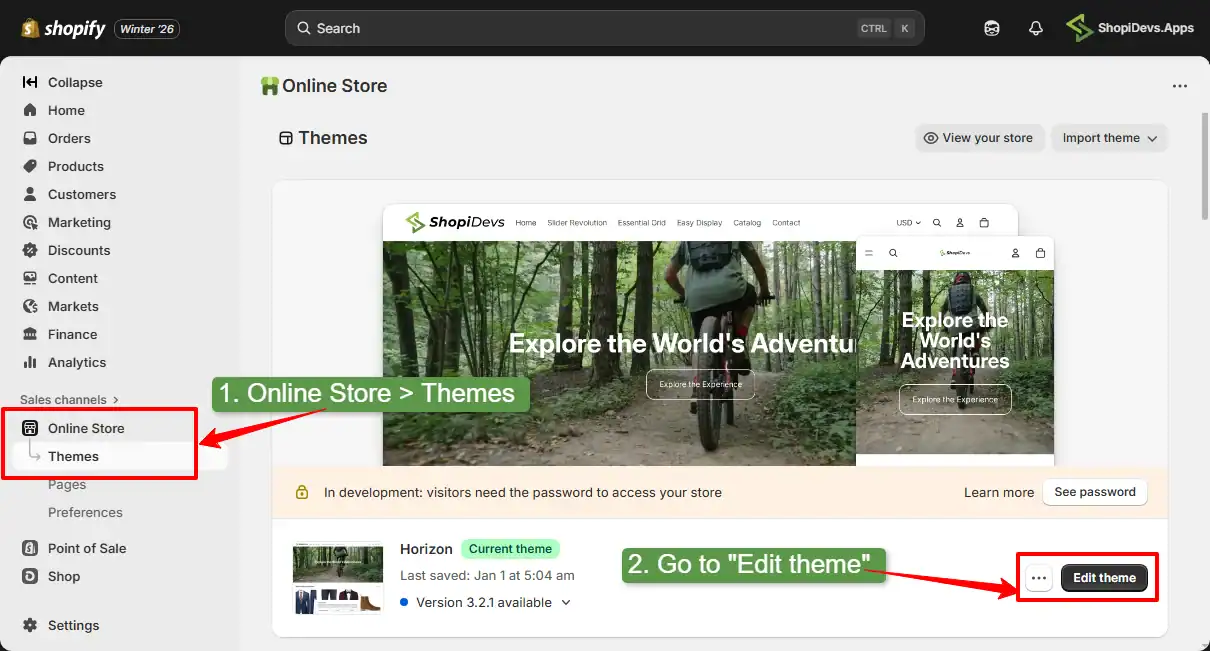
Step 3: Go to the Shopify Theme Editor
- In your Shopify admin, go to Online Store > Themes
- Click Customize on your active theme
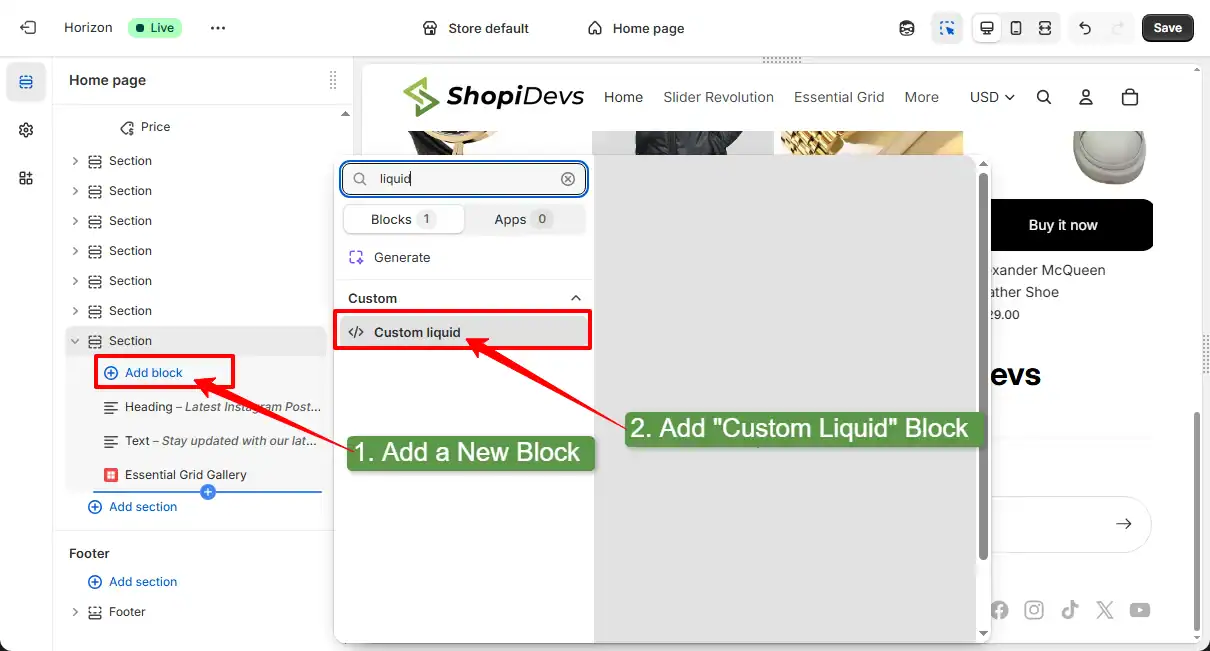
Step 4: Add a Custom Liquid Block
- Navigate to the page or section where you want the post to appear
- Click Add block or Add section
- Search for and select Custom Liquid
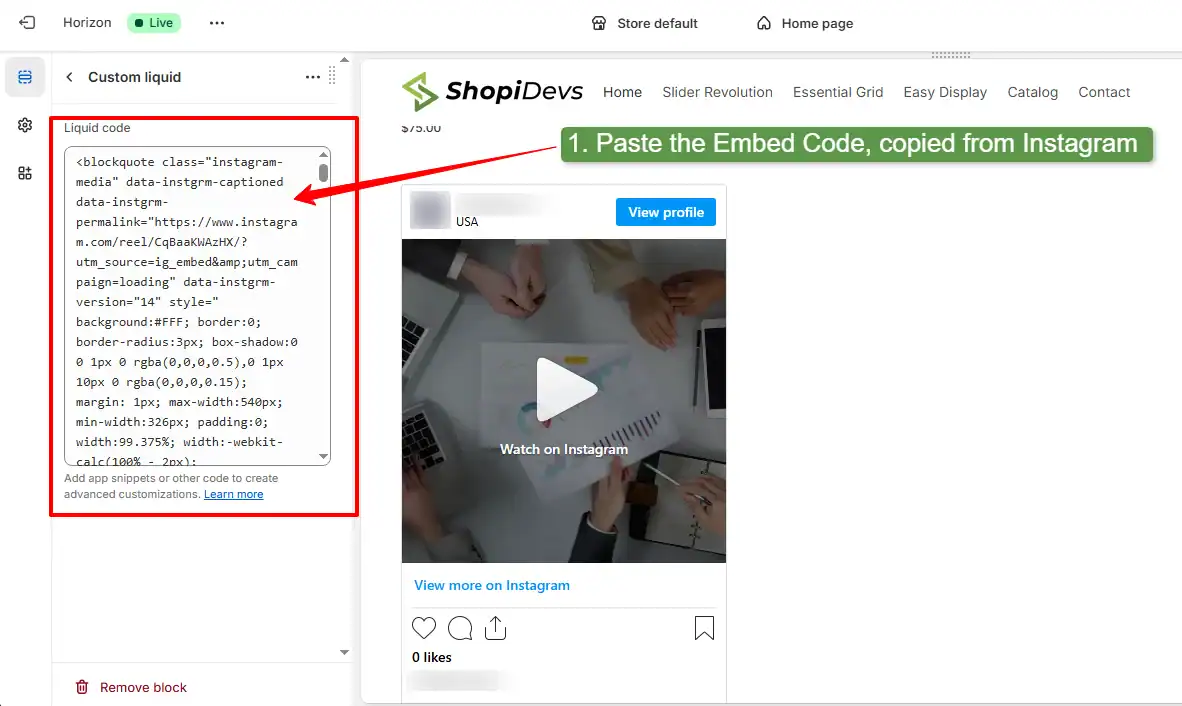
Step 5: Paste the Embed Code and Save
- In the Custom Liquid block, paste the embed code you copied from Instagram
- Click Save in the top right corner of the theme editor
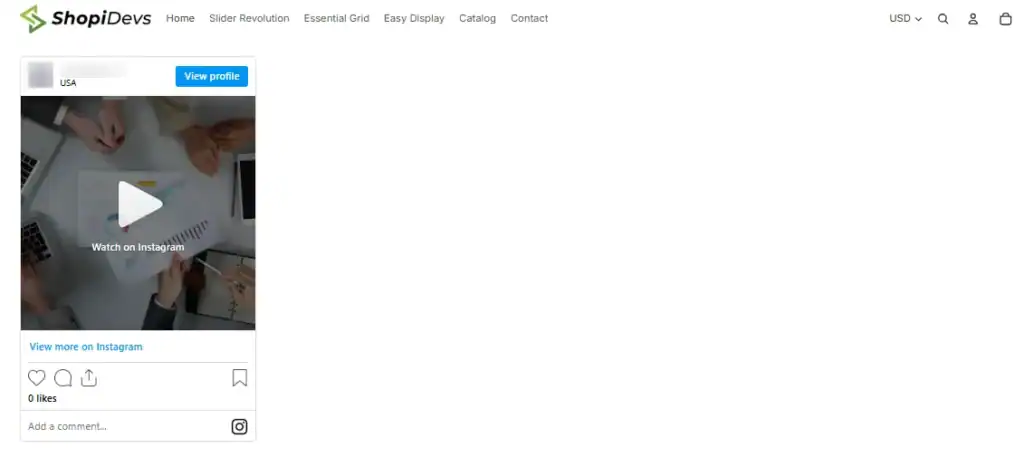
Step 6: Preview the Storefront
Click the eye icon to preview the storefront and confirm the post is rendering correctly. The embedded post will show the image and (if selected) the caption in Instagram’s standard card format.
Note: Instagram’s manual embed feature only works with public posts and Reels. Content from private accounts cannot be embedded. It is also not a practical solution for creating an Instagram gallery because every post must be embedded individually and updated manually whenever you want to showcase new content.
Types of Instagram Feeds You Can Add to Shopify
Essential Grid Gallery supports multiple Instagram feed formats. Each serves a different purpose depending on where it appears in your store and what you want visitors to do.
Grid Feed
Shows posts in a uniform square grid that mirrors the Instagram profile layout. Best for homepages and dedicated gallery pages where you want maximum visual coverage.
Carousel Feed
Horizontal scrolling layout that lets visitors swipe through posts. Works well as a section on the homepage or product category pages. See how to set up a full Instagram slider on Shopify for this format. Adding scroll animations to the section around the carousel increases visibility as visitors reach it.
Reels Video Feed
Displays your Instagram Reels as playable videos in a gallery format. Best for brands with strong video content: product demos, tutorials, behind-the-scenes, or UGC video reviews. Combine with a video carousel for maximum engagement.
Shoppable Feed
Adds clickable hotspot tags on posts that link directly to product pages. Visitors click a lifestyle photo and go straight to buy the product shown. Particularly effective for fashion, beauty, and home decor stores. Pairs naturally with a full shoppable lookbook.
Masonry Feed
Pinterest-style layout with posts at varying heights. Creates a dynamic visual effect that encourages scrolling. Best for brands with a mix of portrait and landscape photography. Works especially well with modern Shopify themes.
Story Highlight Feed
Displays a row of circular story-style thumbnails linking to specific content. Works as a navigation element or a visual brand story strip near the top of the homepage.
Troubleshooting Common Instagram Feed Issues on Shopify
Instagram feed shows an “expired token” or “Reconnect account” error
Instagram access tokens periodically expire. Disconnect your Instagram account inside the Essential Grid Gallery dashboard, reconnect it, and authorize access again. If the issue persists, verify that your Instagram account is still connected as a Business or Creator account.
Instagram feed is not loading on mobile
Check whether your cookie consent platform is blocking the gallery script. Also test by temporarily disabling gallery lazy loading to identify potential conflicts with your theme’s mobile layout.
Instagram Reels are not appearing
Ensure your Instagram account is using a Business or Creator profile and that media permissions were approved during account connection. Personal accounts have API limitations that prevent Reel access.
The Instagram feed is slowing down my Shopify store
Enable lazy loading so gallery images load only when visitors scroll to them. Limiting each gallery to 9 to 12 posts also improves performance while maintaining a visually engaging layout. Check your theme’s compatibility with app blocks to ensure there are no script conflicts adding extra load time.
The feed is displaying posts from the wrong Instagram account
Disconnect the connected Instagram account, clear your browser cache, and reconnect using the correct account. If multiple Instagram accounts are linked to the same Meta Business Manager, carefully select the correct profile during authorization.
Frequently asked questions
How do I connect Instagram to Shopify?
Install an Instagram feed app like Essential Grid Gallery, open the app dashboard, and click “Connect Instagram Account.” You will be prompted to log in to your Instagram Business or Creator account and approve access. Once connected, the app syncs your posts automatically. For a full walkthrough of the connection process, see our guide on how to connect Instagram to Shopify.
Do I need a business Instagram account to add a feed to Shopify?
Yes, for gallery-style integration. Instagram’s API restricts gallery access for personal accounts. You need an Instagram Business or Creator account linked to a Facebook Page to use apps like Essential Grid Gallery. Converting a personal account to a Business or Creator account is free and takes about 2 minutes in Instagram settings.
Can I add a shoppable Instagram feed to Shopify?
Yes. Essential Grid Gallery supports shoppable hotspots: clickable tags on Instagram posts that link directly to Shopify product pages. Set this up in the gallery editor by enabling the hotspot feature and assigning product URLs to specific posts. This turns lifestyle photography into a direct conversion path without the visitor needing to search for the product separately.
What is the best Instagram feed app for Shopify?
Essential Grid Gallery is the strongest option for most Shopify stores. It supports all feed formats (grid, carousel, masonry, shoppable, Reels), has a 4.9-star rating with 207 reviews, loads fast with lazy loading enabled, and has a free plan that covers 1 gallery. For stores that only need a basic feed with minimal customization, Instafeed is a simpler alternative.
How many Instagram posts should I display in the gallery?
For homepage sections, 6 to 9 posts is the standard. Enough to show brand activity without creating a layout-heavy section that pushes product content down the page. For dedicated gallery or lookbook pages, 12 to 24 posts works well with a masonry or grid layout. Avoid displaying more than 24 posts per gallery without pagination enabled, as it increases initial page load time.
Add an Instagram Feed Gallery to Your Shopify Store
Essential Grid Gallery connects directly to your Instagram account and publishes your feed as a grid, carousel, masonry, or shoppable gallery. Free plan available. No code required.

Jakaria is an SEO Content Writer in Shopify, Ecommerce, WordPress, and Tech Industry with 5+ years of experience. He specialises in developing engaging, helpful content by simplifying complex topics into an amazing story for B2B, SaaS, and Shopify businesses. He’s also passionate about staying updated on growth marketing strategies and Shopify trends.